
Secret codes feel like play, but they quietly ask children to slow down, compare details and keep several small clues organized. That combination makes a symbol decoder a strong screen-free activity for early elementary learners.
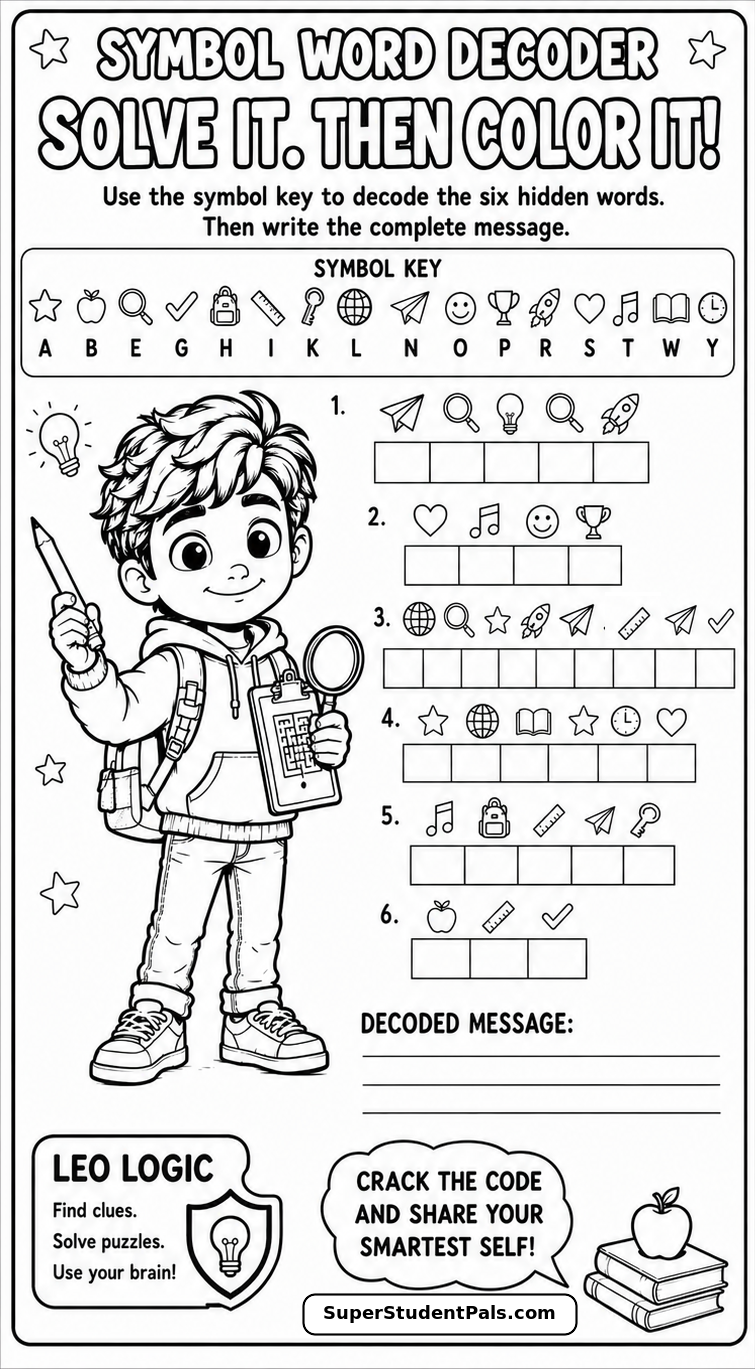
In Leo Logic’s challenge, children use a picture key to decode six words. Those words combine to reveal the encouraging message, “Never stop learning, always think big.” After the puzzle is solved, the entire page becomes a coloring activity.
Download the free secret code activity
Print the activity page on standard paper and keep the answer key nearby for a grown-up, teacher or homeschool helper. For the best puzzle experience, give your child only the activity page at first.

Today’s logic mission
Match each picture symbol to its letter, decode all six words and write the complete hidden message.
Solve it. Then color it!What children practice while cracking the code
Visual discrimination
Children must notice the difference between icons, locate the matching icon in the key and resist guessing from shape alone. This supports the careful visual scanning used in reading, math and classroom directions.
Letter recognition and spelling
Each symbol produces one letter. As the boxes fill, children can use familiar spelling patterns to check their work. If a decoded word looks wrong, the page gives them a reason to revisit the clue instead of waiting for an adult to supply the answer.
Working memory and sequencing
The child moves through one symbol at a time while remembering where they are in the word. The final step—combining six separate answers into one sentence—adds an age-appropriate sequencing challenge.
Persistence
A code rarely reveals itself all at once. Children experience a series of small wins: one symbol, one word and finally the full message. That makes persistence visible and rewarding.
How to use this printable without turning it into homework
- 1
Introduce the mission
Say, “Leo left us a secret message. Can you crack it?” Keep the opening playful and brief.
- 2
Solve one example together
Point to the first symbol, find its match in the key and write the letter. Then let your child continue.
- 3
Use a paper marker
A scrap of paper under the active row helps a child track across the symbols without losing their place.
- 4
Read each finished word aloud
This gives children a natural spelling check before they move to the next row.
- 5
Celebrate the complete message
Read it together, talk about what “think big” means and then bring out the crayons.
Turn the decoder into a reading-confidence game
For a child who resists reading, the decoder offers something a full page of prose may not: a visible finish line. Cover all but the first two coded words, let your child choose a pencil color and agree that those two words are the whole mission. When they finish, read the words together and ask whether they want to uncover another row.
Keep your feedback specific: “You checked the key twice,” “You noticed that letter did not make sense,” or “You stayed with a tricky word.” Those comments focus on strategies the child can use again. If books have already become a source of conflict, pair this activity with the seven low-pressure ideas in Mrs. Bloomwell’s guide for what to do when a child does not want to read.
What to do when your child gets stuck
A helpful prompt should narrow the task without solving it. Try: “Find that exact picture in the key,” “Check the symbol before and after it,” or “Does that finished word look like a word you know?”
If the full key feels visually busy, cover most of it with two pieces of paper and reveal only a few symbols at a time. For a child who tires easily, solve three words now and return for the remaining three later. Finishing in two short sessions still counts as independent practice.
Leo Logic symbol decoder answer key
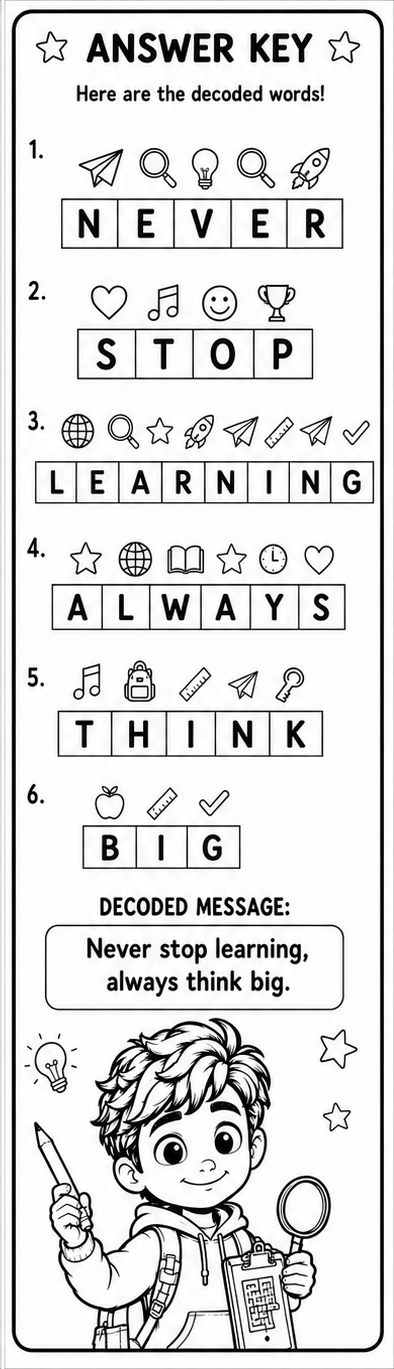
The six decoded words are Never, Stop, Learning, Always, Think and Big. Together they reveal: “Never stop learning, always think big.”
Frequently asked questions
What age is this secret code activity for?
The page is designed for children ages 6–8 and Grades 1–3. Younger children can solve it with a grown-up pointing to the matching symbols, while older children can work independently.
What skills does a symbol decoder practice?
Children scan a visual key, match symbols to letters, hold information in working memory, spell familiar words and combine separate answers into one complete message.
Should I correct a wrong letter immediately?
Pause first and ask your child to compare the symbol with the key again. A small prompt preserves the problem-solving moment while keeping frustration low.
Can children color the page before solving it?
Yes, but solving first gives the coloring step a natural reward feeling. The Super Student Pals format is designed around the rhythm: solve it, then color it.
Can this help a child who avoids reading?
It can provide a short, playful reading win because each decoded word has a clear purpose and stopping point. Keep the tone light, offer help with the first symbol and stop before frustration grows. A puzzle can support confidence, but it does not replace reading instruction or an evaluation when difficulty persists.
More screen-free missions
Want a full printable sampler?
Get puzzles, coloring activities and answer pages from across the Super Student Pals’ five learning zones.
Get the free sampler